Defination
Here is the Euler-Lagrange’s equation:
\frac{\mathrm{d}}{\mathrm{d}t}(\frac{\partial{\mathcal{L}}}{\partial{\dot{q_i}}})=\frac{\partial{\mathcal{L}}}{\partial{q_i}} \tag{1}
Where \mathcal{L} is the Lagrangian, defined as T-V.
In Mathematica, we can compute it directly by calling the VariationalMethods package:
Needs["VariationalMethods`"]
L = T - V
EulerEquations[L, {q1[t], q2[t]}, t]
Example
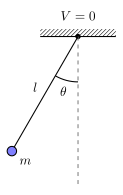
\documentclass[tikz,border=5pt]{standalone}
\usetikzlibrary{patterns}
\usepackage{amsmath}

\begin{document}
\begin{tikzpicture}[>=stealth, thick]
    \def\angle{30}
    \def\len{3.5}

    \fill [pattern = north east lines] (-1,0) rectangle (1,0.2);
    \draw (-1,0) -- (1,0);

    \node[above] at (0,0.3) {$V = 0$};
    \fill (0,0) circle (2pt);

    \draw [dashed, gray] (0,0) -- (0,-4);

    \draw (0,0) -- ({-90-\angle}:\len)
        node[midway, left, xshift=-2pt, yshift=5pt] {$l$};

    \node[circle, fill=blue!50, draw, inner sep=2.5pt] (ball) at ({-90-\angle}:\len) {};
    \node[below right=2pt] at (ball) {$m$};

    \draw (0,-1.2) arc (-90:{-90-\angle}:1.2);
    \node at ({-90-\angle/2}:1.5) {$\theta$};

\end{tikzpicture}
\end{document}
Choose the angular displacement \theta (the angle between the pendulum and the vertical) as the generalized coordinate.
\mathcal{L} =\frac{1}{2}ml^2 \dot{\theta}^2+mgl\cos{\theta} \tag{2}
Which set V=0 at the pivot point. Use Euler-Lagrange equation, we have: l\ddot{\theta}+g\sin{\theta}=0 \tag{3}
Solution
\dot{\theta}\ddot{\theta}+\frac{g}{l}\dot{\theta}\sin{\theta}=0 \\ \tag{4}
\frac{\mathrm{d}}{\mathrm{d}t}(\frac{1}{2}\dot{\theta}^2-\frac{g}{l}\cos{\theta})=0 \tag{5}
Let \theta=\theta_0 when t=0 : \dot{\theta}^2=\frac{2g}{l}(\cos{\theta}-\cos{\theta_0}) \tag{6}
t=\sqrt{\frac{l}{2g}} \int_0^{\theta} \frac{1}{\sqrt{\cos{\theta}-\cos{\theta_0}}}\mathrm{d}\theta \tag{7}
Use double-angle formula \cos{2x}=1-2\sin{x}^2 and let \sin{\frac{\theta}{2}}=k\sin{\phi} : t=\sqrt{\frac{l}{g}}\int_0^{\arcsin{\frac{1}{k}\sin{\frac{\theta}{2}}}}\frac{1}{\sqrt{1-k^2\sin{\phi}^2}} \mathrm{d}\phi \tag{8}
Where k=\sin{\frac{\theta_0}{2}}. For the period T, the process is \theta_0 \to 0 \to -\theta_0 \to 0 , so: T=4\sqrt{\frac{l}{g}}\int_0^{\pi/2}\frac{1}{\sqrt{1-k^2\sin{\phi}^2}} \mathrm{d}\phi \tag{9}
This is the Complete Elliptic Integral of the first Kind, which can be written as: T=4\sqrt{\frac{l}{g}}K\left(\sin{\left( \frac{\theta_0}{2} \right)}\right) \tag{10}
Using the power series expansion of K(k) , we obtain: T=2\pi\sqrt{\frac{l}{g}}\sum_{n=0}^{\infty}\left( \frac{(2n)!}{2^{2n}(n!)} \right)^2 \sin^{2n}\left( \frac{\theta_0}{2} \right) \tag{11}